Life Style
Paul McCartney Takes Issue With Staged Stature Beside Lennon in Upcoming Beatles Biopics

Oct
An October 13 discussion reexamined a defining icon of music history, casting fresh scrutiny on Sam Mendes’s ambitious cinematic portrait of the legendary quartet.
Sir Paul McCartney has voiced a remarkably precise grievance regarding Sam Mendes’s expansive four-part cinematic project chronicling the Beatles, pointing to a production still from a restaged Abbey Road crossing where the actor portraying McCartney appears notably shorter than his counterpart playing John Lennon. Addressing the media on October 13, the 84-year-old music icon revealed that he reached out to Mendes upon viewing the promotional image, urging the director to avoid repeating a physical misrepresentation that McCartney feels has persisted in earlier dramatizations of the band.
While initially appearing as a minor casting critique, McCartney’s observation speaks directly to underlying group dynamics. In his firsthand recollection, he, Lennon, and George Harrison stood at virtually identical heights, with Ringo Starr standing slightly shorter. Projecting Lennon conspicuously above McCartney on screen introduces a misleading visual hierarchy, subtly implying an unbalanced power dynamic between two creative partners whose legendary collaboration and rivalry built the foundation of the Beatles.
According to McCartney, Mendes explained that the discrepancy stemmed from the actors’ distinct strides during the photo sequence, subsequently supplying an alternative image depicting them on equal footing. This interaction indicates neither a public dispute nor a production crisis, but rather highlights the meticulous scrutiny accompanying an unprecedented film endeavor: a surviving member is observing intently as Hollywood translates one of the most recognized lineups in modern music history into distinct starring roles.
A Historic Zebra Crossing That Leaves No Detail Unscrutinized
The immortalized Abbey Road album cover originated from a concise photo shoot on August 8, 1969, outside the group’s London recording studios. Photographer Iain Macmillan captured the four musicians marching in single file across the zebra crossing, led by Lennon, followed by Starr, McCartney, and Harrison. The resulting composition transformed an ordinary London street into pop culture’s most famous intersection, omitting both the band’s moniker and the album title from the front sleeve.
This deceptive simplicity presents an inherent trap for filmmakers. Devoid of high-stakes stunts, costume changes, or complex dialogue, the scene consists solely of four figures, asphalt, everyday attire, and negative space. Anyone familiar with the original artwork can spot proportional shifts instantly. Recreating the photograph carries an implicit promise of authenticity, yet it simultaneously invites viewers to measure cinematic portrayals against an image etched deeper into public memory than most real-life moments from the band’s career.
This contextual weight explains why McCartney’s reaction to Mendes’s production still extends far beyond superficial concerns about personal vanity. The proportions captured on the original album cover form an integral element of a composition absorbed by global audiences over decades. Minor variations in stature, posture, or inter-figure spacing can subtly distort how viewers perceive the group’s internal relationships, even when actors are simply taking a stride forward.
McCartney addressed the topic during a discussion with Amy Poehler when queried about the band’s relative heights, responding instantly: “We were all the same height,” while noting Starr’s slightly shorter stature. He subsequently connected this reality to cinematic depictions that historically cast Paul as smaller and more deferential than John. His remarks sought no inflated or heroic stature, but rather a refusal to let established cinematic shortcuts redefine the balance he remembers.
McCartney has previously voiced similar frustrations. In Sam Taylor-Johnson’s 2009 biographical drama Nowhere Boy, Aaron Taylor-Johnson portrayed Lennon alongside Thomas Brodie-Sangster as a younger McCartney—a portrayal McCartney felt left his younger self looking physically overmatched. His objections at the time were met with the reminder that the project was a dramatic feature rather than a documentary, and his recent October statements indicate the sentiment has lingered.
The subject resurfaces now within a much grander production framework. Paul Mescal has stepped into the role of McCartney, with Harris Dickinson cast as Lennon. While real-world anatomical differences between the actors create the precise visual discrepancy McCartney cautions against, cinematic tools such as camera framing, physical direction, and editing offer ample flexibility. The dialogue described between McCartney and Mendes demonstrates both the underlying obstacle and its resolution: an initial production frame caused concern, while a subsequent image successfully addressed the critique.
Four Distinct Perspectives and the Challenge of Shared History
The complexity of the undertaking is heightened by Mendes’s unconventional narrative structure, abandoning a standard compressed biographical format in favor of four intersecting theatrical features. Officially titled The Beatles—A Four-Film Cinematic Event, the project dedicates a standalone film to the viewpoint of each band member. Mescal portrays McCartney, Dickinson plays Lennon, Joseph Quinn takes on Harrison, and Barry Keoghan stars as Starr, with their individual narratives designed to weave together rather than stand as isolated portraits.
This multi-perspective format holds obvious appeal. Summarizing the group’s historic trajectory into a handful of familiar milestones can benefit immensely from exploring four distinct internal viewpoints. Incidents perceived as liberating by one member may have registered as profound losses to another. Creative breakthroughs, recording sessions, and internal disputes shift in emotional resonance depending on whose perspective commands the frame, offering filmmakers a powerful tool to examine unity without assuming monolithic recollection.
Simultaneously, this ambitious approach introduces the precise vulnerability highlighted by McCartney’s critique. In a multi-narrative framework, the visual framing of one central figure inevitably influences the others. If Lennon is consistently depicted as taller, more dominant, or physically imposing, that dynamic becomes an intentional or inadvertent narrative device. Consequently, the actor portraying McCartney must perform against pre-established visual biases, making McCartney’s focus on pre-dialogue framing entirely justified.
Naturally, parity in height does not guarantee historical fidelity. Lennon and McCartney possessed distinct temperaments, requiring dramatic performances to convey complex interpersonal tensions effectively. Feature films frequently necessitate compressed timelines, amalgamated encounters, or stylized visual contrasts to guide viewers through narrative arcs. Nevertheless, distinguishing between constructive dramatic license and avoidable physical distortion remains critical when subjects retain instant recognition among millions familiar with their actual appearance.
Unprecedented cooperation from the band’s estate holders distinguishes this production from past cinematic efforts. Paul McCartney, Ringo Starr, and the surviving estates of John Lennon and George Harrison have granted comprehensive life-story and music rights for the scripted features. This unprecedented access enables the filmmakers to anchor dramatic tension directly in the group’s authentic recordings rather than relying on generalized approximations. Institutional backing, however, does not preclude creative friction over specific interpretive choices.
Mendes is producing alongside Pippa Harris and the Neal Street Productions team, supported by screenwriters Jez Butterworth, Peter Straughan, and Jack Thorne. This collaborative assembly brings diverse creative sensibilities to bear on an unparalleled archive of musical history. As the scope of the enterprise expands, maintaining rigorous attention to detail becomes paramount to ensure credibility across all four cinematic installments.
Why Visual Authenticity Holds Weight for the Music’s Legacy
Beneath the discussion of physical dimensions lies a fundamental question: who holds authority over how a band’s internal dynamic is visualized? Over decades, the Beatles’ legacy has been revisited through documentaries, authorized films, biographies, stage tributes, and studio recordings. Each medium highlights specific facets while omitting others, yet the physical portrayal of the musicians exerts a powerful subconscious influence on audience perception.
Popular culture frequently casts Lennon as the abrasive, confrontational intellectual and McCartney as the diplomatic, melodic architect. While neither archetype captures the full complexity of the real individuals, cinematic storytelling often amplifies such distinctions, particularly when reinforced by visual staging. Framing a shorter McCartney beside an elevated Lennon risks cementing long-standing cultural assumptions into unquestioned cinematic fact.
This subtle nuance underscores the validity of McCartney’s intervention. He advocated neither for airbrushed sanitization nor for manufactured parity in every dramatic confrontation; rather, he challenged a specific visual shorthand that he felt compromised earlier portrayals. His assertion that he and Lennon stood as equals serves as a vital reminder of how direct personal testimony can challenge stylized interpretations constructed by filmmakers.
The Abbey Road sequence intensifies this scrutiny because the photograph functions simultaneously as historical document and global icon. Captured on a August morning in 1969, the image crystallizes the band’s collective identity into four figures moving forward in unison. By the time the sleeve hit shelves in September, the group had completed their final recording sessions, cementing the ordinary London crossing as an unintended visual signifier of an era drawing to a close.
Any cinematic recreation inherits this heavy symbolic baggage. A successful recreation invites viewers seamlessly into 1969, whereas a miscalculated frame risks jarring audiences out of the narrative due to obsessive familiarity with the source material. While directors enjoy greater artistic latitude within controlled studio environments devoid of rigid visual templates, iconic public touchstones leave no room for error.
The enduring durability of the original sleeve is evident in its continuous cultural reproduction across global tourism and merchandise. While unrelated to current box-office developments, commemorative items such as the Abbey Road–themed decorative pillow illustrate how powerfully a single visual layout communicates before explanatory text is ever read.
McCartney’s public feedback arrives at an opportune stage of production while principal work remains ongoing. Without issuing ultimatums regarding reshoots, his dialogue with the director highlights that key figures whose lives are being adapted remain vigilant about granular details that production teams might otherwise overlook.
A Cinematic Milestone Facing Deeper Narrative Challenges
The four theatrical features are slated for commercial release in April 2028. During a recent film festival panel, producer Pippa Harris outlined plans for audiences to consume all four segments within a closely coordinated release window, though scheduling specifics remain flexible. Fundamentally, the films are conceived as interdependent cinematic experiences designed to yield maximum impact when viewed collectively.
This structural strategy imposes a rigorous standard of narrative continuity. Patrons navigating sequential viewpoints may encounter overlapping events framed through divergent emotional lenses. While contrasting perspectives deepen character study, careless narrative contradictions risk alienating viewers. Ensuring seamless alignment between subjective character interpretations and objective historical facts across four separate films represents a formidable creative hurdle.
Pending the release of initial footage, production stills and behind-the-scenes discussions offer merely a preliminary glimpse into an evolving creative process rather than definitive proof of final quality. Nevertheless, they pinpoint the inherent vulnerabilities of the project: four acclaimed actors tasked with embodying living legends whose public profiles have never dimmed, performing before an audience intimately familiar with every facet of their history.
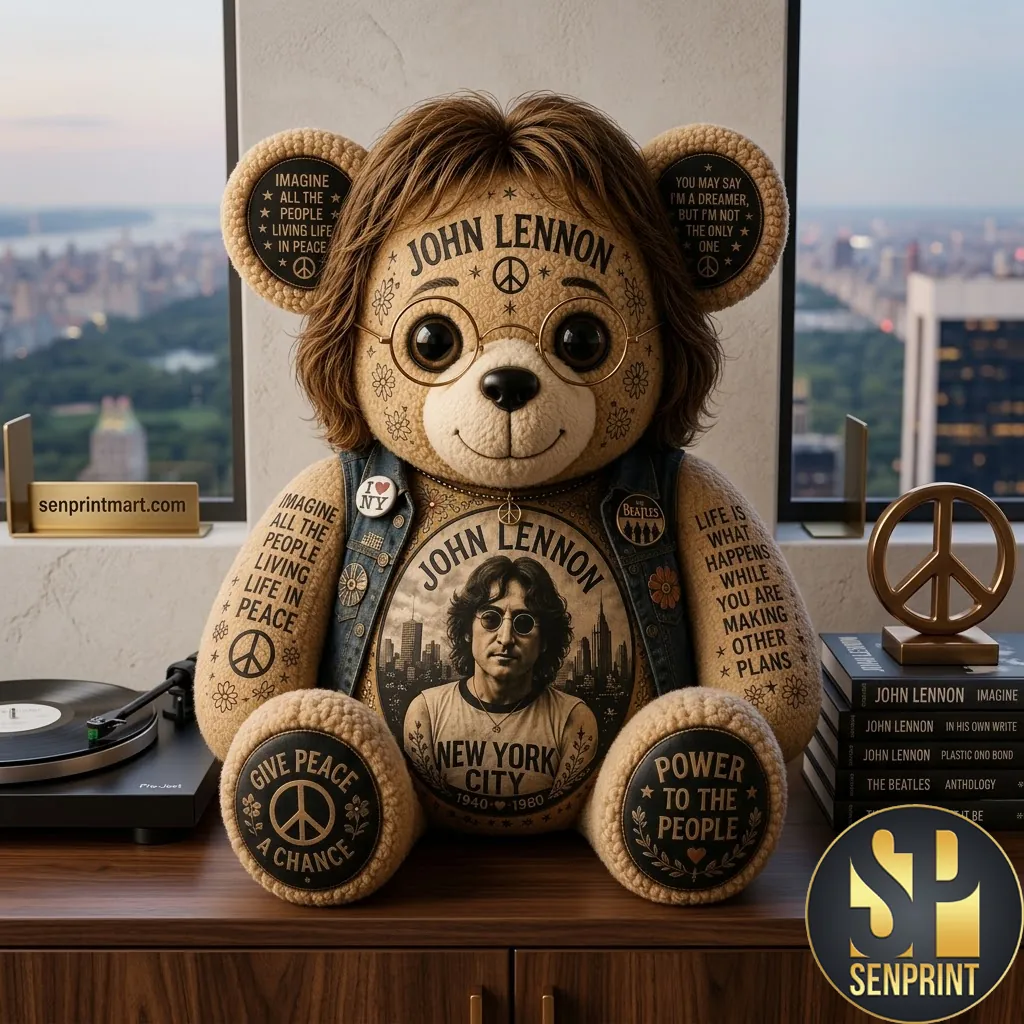
This deep cultural familiarity extends across consumer markets through enduring merchandise tributes. Items like a John Lennon–themed commemorative pillow capture distinct chapters of Lennon’s artistic identity independent of the Abbey Road crossing. While cultural rather than commercial, these touchpoints underscore the profound emotional attachments fans maintain toward individual band members.
Ultimately, McCartney’s remarks underscore that authenticity in biographical filmmaking encompasses physical staging as well as musical scoring. Within a narrative examining complex human relationships, visual proportions silently communicate authority and parity. As Mendes shapes his fourfold exploration of the Beatles, McCartney has established a clear baseline for his portrayal: standing shoulder-to-shoulder with Lennon, exactly as he remembers.
Featured Product Collection
Explore our curated selection of music memorabilia, fan collectibles, and themed home accents inspired by legendary artists.