Life Style
Before Jason’s Mask, ‘Crystal Lake’ Shifts the Terror Back to His Mother
Oct
Television producers reviving the Friday the 13th universe have opted for a deliberate and revealing departure: in this upcoming iteration, the defining visage of Camp Crystal Lake remains unmasked. During a panel at New York Comic Con on October 8, the creative team behind Crystal Lake detailed why their prequel centers squarely on Pamela Voorhees—the grieving matriarch whose tragic vengeance catalyzed the legendary slasher franchise. This narrative choice roots a towering horror icon within a deeply human tragedy.
This bold perspective shift faces its inaugural public test on October 15, when all eight episodes debut on Peacock. As the premiere approaches, the series raises a compelling question for franchise devotees: can a property defined by Jason Voorhees’ towering physical menace successfully sustain a dramatic narrative anchored by the architect of his mythos? Far from softening the lore of Camp Crystal Lake, the production challenges audiences to examine iconic violence through a perspective previously unexplored by feature films.
A central revelation from the October 8 panel concerned the deliberate decision to set the series in the 1970s. Showrunner Brad Caleb Kane characterized the decade as an era defined by widespread skepticism toward institutions, traditional certainties, and societal norms. Pamela’s internal turmoil, he noted, mirrors this broader cultural disorientation on an intimate scale: stripped of her child, she must navigate an existence devoid of the maternal identity that defined her. Consequently, the period backdrop functions as more than mere aesthetic window-dressing for vintage automobiles, period attire, and a disconnected summer setting.
Shifting the Narrative: When the Antagonist Takes Center Stage
Linda Cardellini stars as Pamela—referred to as Pam in the series—alongside Callum Vinson as a young Jason. The narrative commences in the aftermath of Jason’s drowning at Camp Crystal Lake, an unresolved catastrophe that consumes his mother’s psyche. When inquisitive strangers begin probing her history, their arrival ignites a cascade of suspicion and violence across the lakeside community. The plot seeks to answer a query that the original 1980 feature film preserved as a climactic twist: what shaped Mrs. Voorhees into the terrifying force she ultimately became?
The foundational 1980 film relied heavily on concealing the killer’s identity until its final moments, with Betsy Palmer’s chilling performance anchoring the revelation that the carnage stemmed from maternal grief. Over subsequent sequels, however, Jason evolved into the franchise’s inescapable emblem, cementing his hockey mask as pop-culture iconography. Crystal Lake inverts this traditional storytelling hierarchy. Rather than withholding Pam until the denouement, the series tracks her trajectory proactively, compelling viewers to follow her path even as her actions descend into indefensible territory.
This structure generates an entirely distinct brand of tension. While a masked antagonist terrifies through anonymity and unpredictable strikes, a narrative anchored by Pam derives suspense from observing human choices, obscured motives, and the rationalization of violence as maternal devotion. Viewers may comprehend her harrowing circumstances long before endorsing her methods. If the characterization resonates, the resulting threat gains potency precisely because the perpetrator operates in plain sight.
Cardellini brings remarkable range to the production, drawing on an acclaimed career traversing comedy, domestic drama, mystery, and dark narrative territory across projects such as Freaks and Geeks, Dead to Me, and Scooby-Doo. Following her Emmy win in 2026 for supporting work in DTF St. Louis, her diverse filmography has garnered renewed critical acclaim. During an October 7 appearance on The Tonight Show, she reflected on transitioning from portraying figures fleeing danger to embodying the architect of terror, highlighting the unique demands of her latest role.
For showrunners, Cardellini’s proven ability to inhabit complex, emotionally unstable characters proved far more valuable than casting a conventional horror genre veteran. Kane noted being particularly impressed by her portrayal of grief and deception in Dead to Me. Her new role demands the simultaneous navigation of competing emotional realities: a grieving parent, a survivor, and an architect of monstrosity. These psychological stakes do not merely serve as window dressing for traditional genre kills; they form the narrative core designed to give the bloodshed emotional weight.
A 1970s Community Harbored by Deep-Seated Secrets
Discussions at New York Comic Con also underscored why the creative team avoided a slavish recreation of the original film’s atmosphere. The prequel deliberately expands its scope to encompass the neighboring municipality alongside iconic camp settings. William Catlett portrays Police Chief Levon Brooks, while Devin Kessler features as his sister Briana, an inquisitive journalist investigating local fatalities and municipal cover-ups. Cameron Scoggins rounds out the ensemble as Dorf, a law enforcement officer adapted from the 1980 film’s supporting cast. Together, these figures provide a rich social backdrop absent from traditional isolated-campsite narratives.
The historical era holds specific resonance for Levon and Briana. During the October 8 panel, cast members explored how the experiences of Black Americans within small-town New Jersey during that period informed their performances. This perspective emphasizes that local communities comprise diverse lived realities, apprehensions, and societal expectations, even against the backdrop of dark genre tropes. A police chief and a journalist inevitably navigate shared turmoil through competing professional and personal lenses, reinforcing that the surrounding town harbors layered complexities.
Kane characterized the period as one defined by systemic distrust and social upheaval, mirroring Pamela’s psychological destabilization. While this thematic parallel stops short of framing her crimes as a direct allegory for 1970s political strife, it grounds the narrative in a tangible historical moment. Operating in a pre-digital era devoid of cellular communication and rapid information access, the town becomes a breeding ground where rumors persist, institutions falter, and those closest to tragedy prove uniquely unreliable.
Simultaneously, the series accommodates elements extending beyond conventional psychological realism. Historically, the Friday the 13th franchise balanced visceral terror with high-octane spectacle and dark humor. Producers confirmed that this tradition—including extensive practical gore effects—remains intact while character-driven drama takes center stage. Merging intimate family tragedy with classic slasher tropes presents an inherent tonal tightrope, yet this friction forms a deliberate part of the production’s ambitious creative gamble.
Even iconic visual signifiers are incorporated with restraint. While recognizable wardrobe elements such as Pamela’s signature blue sweater make an appearance, the production avoids attempting a literal replication of Betsy Palmer’s physical performance or appearance. Cardellini depicts a younger iteration navigating events long before the timeline familiar to fans. This temporal distinction is crucial; prequels stumble when functioning merely as checklists for fan service. Allowing a character depth before hardening into cultural iconography represents a challenging yet rewarding creative objective.
Nevertheless, Jason remains a palpable presence. Vinson portrays him during childhood, with creators highlighting his physical evolution as integral to the overarching arc. However, audiences should not anticipate the hockey mask functioning as a primary visual motif, as that imagery belonged to subsequent cinematic chapters. The narrative focus concentrates instead on the preceding era—when Jason remained a vulnerable child in his mother’s perception, and Pamela still viewed herself as a protective guardian rather than a murderer.
A High-Stakes Test That Rises Above Mere Nostalgia
The seasonal timing aligns fortuitously with October’s tradition of horror revivals, though the series deliberately subverts expectations by withholding its most recognizable visual signifier. Rather than leaning on immediate brand recognition, the production emphasizes a foundational plot point frequently overlooked by casual viewers: the primary antagonist of the inaugural film was not an adult Jason, but his grieving mother.
Furthermore, the production leverages authentic geographical ties by filming in and around Blairstown, New Jersey, anchoring the series to the original motion picture’s historic footprint. This decision establishes atmospheric continuity without descending into mimicry, imbuing rural roads and wooded expanses with subtle menace while supporting fresh narrative dynamics. The objective extends beyond orchestrating standard forest pursuits; it explores how an ordinary municipality absorbs decades of unhealed trauma.
Distribution strategy will similarly influence audience engagement. Dropping all eight episodes simultaneously allows viewers to experience Pamela’s psychological descent as an uninterrupted narrative arc rather than episodic increments. Concurrently, this binge format heightens demands for sustained pacing; origin narratives cannot indefinitely postpone momentum by relying solely on future payoffs. Every installment must justify its focus on contemporary townsfolk—a rigorous structural test when adapting a streamlined feature film premise into episodic television.
Inherent pitfalls accompany the venture. Over-exposition risks stripping iconic horror figures of their mystique, whereas under-development risks reducing prequels to filler. Traditional horror enthusiasts craving elaborate set pieces may chafe at protracted character exploration, while viewers drawn to psychological tragedy might struggle with genre-typical violence. The creative team strives to reconcile these competing viewer expectations, though ultimate success remains dependent on the execution across the complete season.
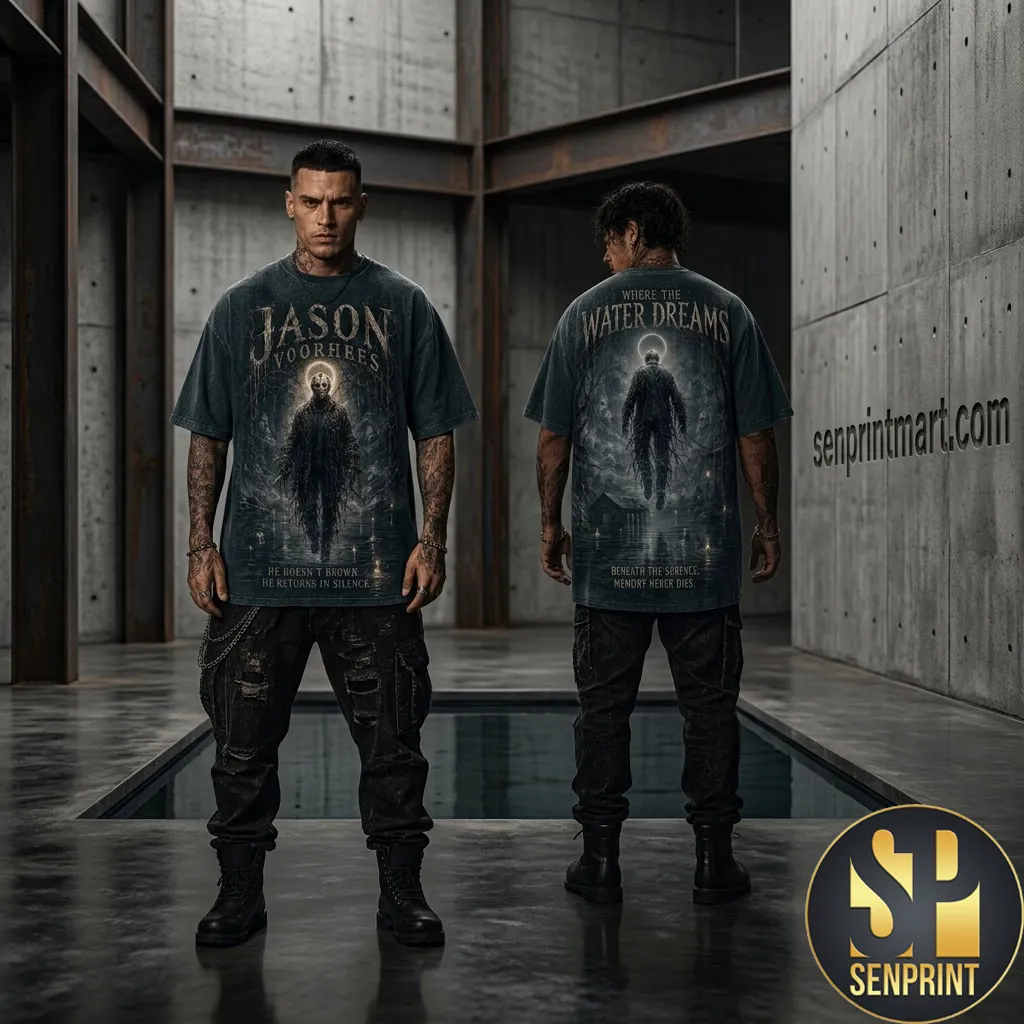
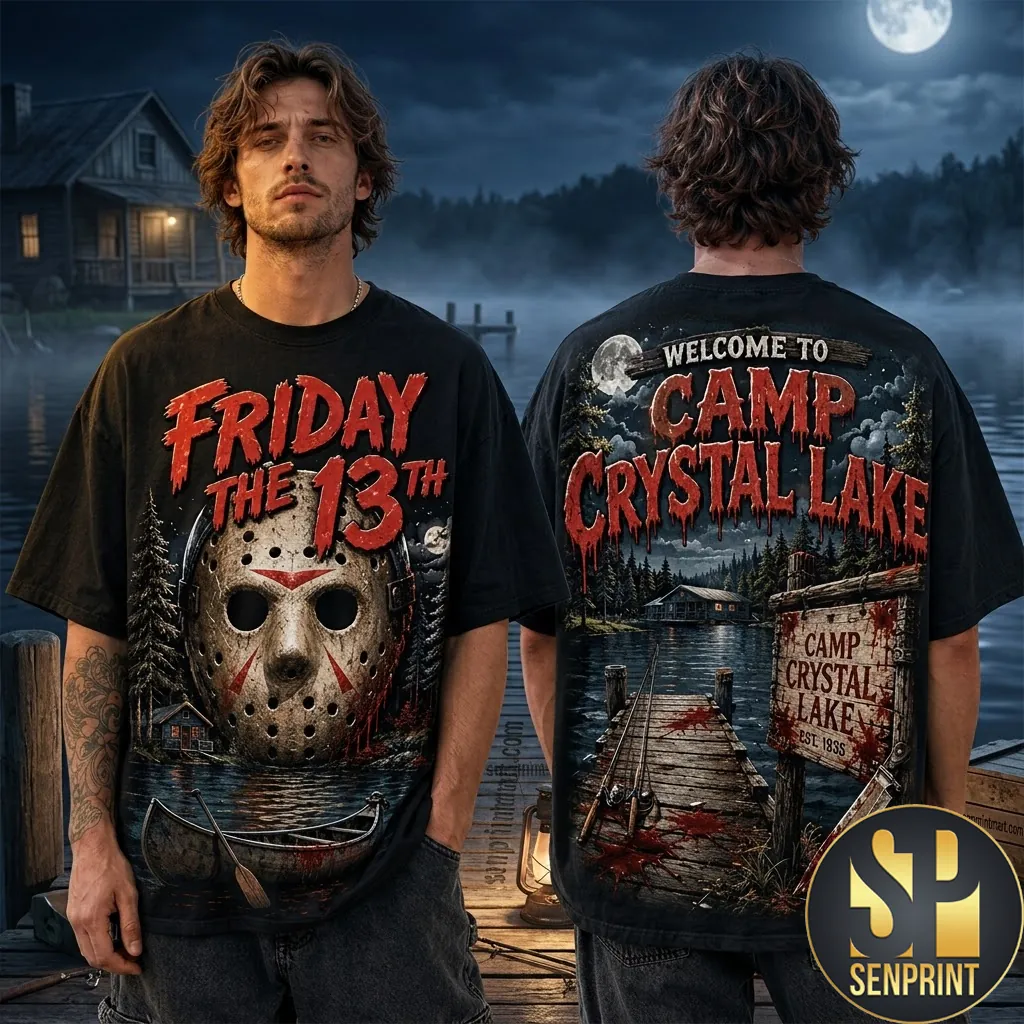
For enthusiasts, however, this reinterpretation enriches how legacy merchandise is perceived. Apparel such as the Friday the 13th Jason Voorhees Camp Crystal Lake graphic shirt and the Jason Voorhees Where the Water Dreams graphic T-shirt serves as dual entry points into a shared mythology, celebrating distinct facets of the cinematic universe without implying direct affiliation with the current series.
This phenomenon extends across the broader horror landscape. Properties like Halloween, Child’s Play, Scream, and The Conjuring demonstrate how genre cinema elevates characters and props into enduring cultural artifacts. While their respective mythologies remain distinct, Crystal Lake aligns with enduring horror traditions by recognizing that audiences derive deep dread from familiar lore. The true test lies in generating fresh psychological resonance rather than recycling recognizable iconography.
Beginning October 15, Crystal Lake faces the ultimate judgment of its creative vision. While public consciousness recognizes Jason as an avatar of silent terror, the series posits that profound horror stems from the maternal figure who loved, lost, and conflated retribution with devotion. The hockey mask remains shelved for now; for the first time in decades, the journey to Camp Crystal Lake originates with Pamela Voorhees.
Explore the Complete Product Collection
Discover the full selection of apparel, collectibles, and fan merchandise.